Lesson
Tight stops
By Thomas Jamais (Backtestd) · Published · Updated
Watch the videos
Short videos about this test. Each one has its own page.
In short
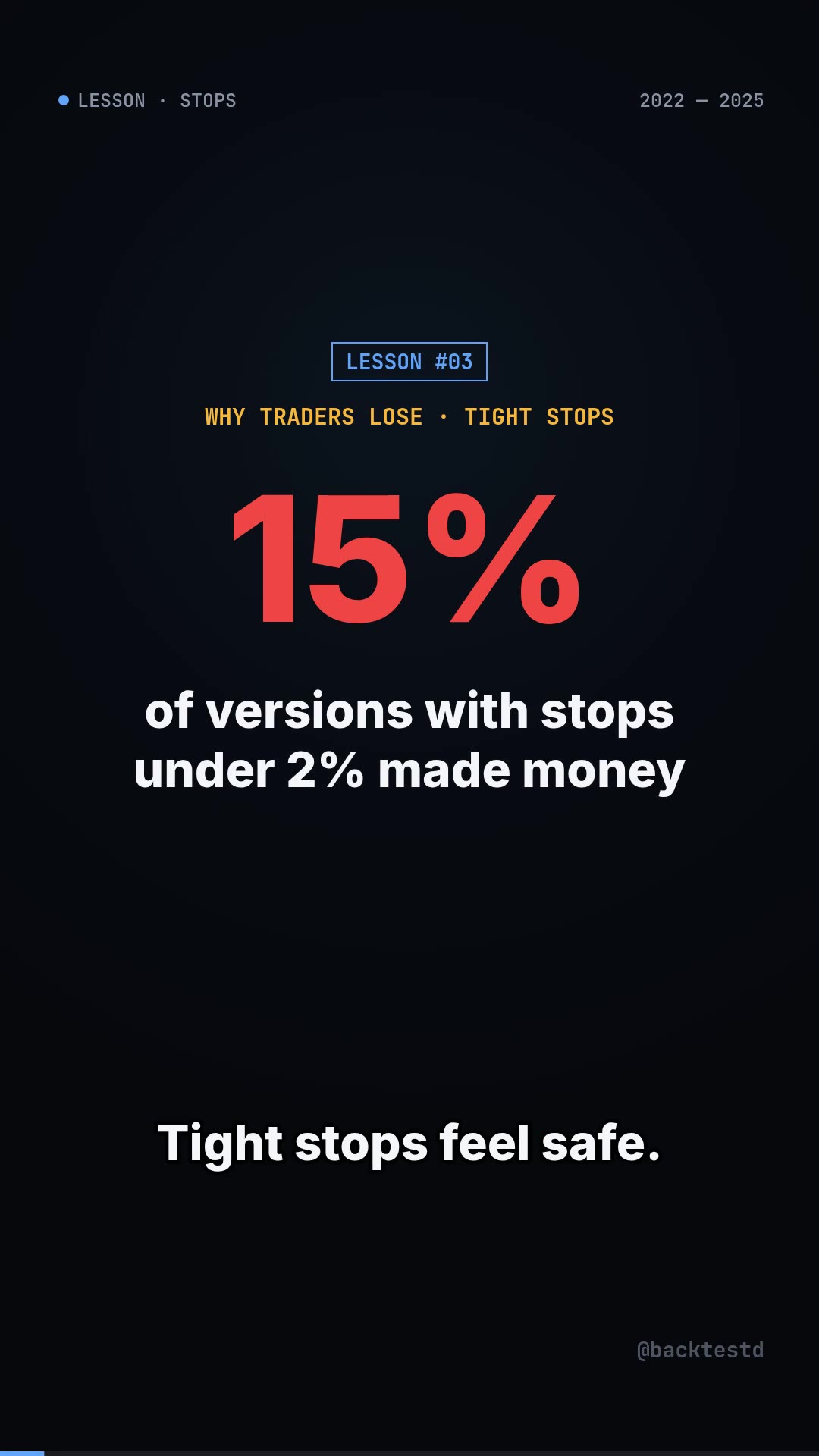
Tight stops feel safe. In our tests, only 10% of versions with stops under 2% of price made money.
Wider stops did better at every step: 61% of versions with stops over 8% made money. A tight stop gets hit by noise, and every hit costs fees.
A stop is where your idea is wrong, not where you feel uncomfortable.
The numbers
| Group | Value |
|---|---|
| <2% | 10% |
| 2–4% | 24% |
| 4–8% | 54% |
| >8% | 61% |
How we measured it
Every number comes from the lab's database: 20731 strategy versions with at least 100 trades each, tested on crypto perpetual futures from 2022 to 2025 with fees, slippage and funding. One version = one strategy with one set of settings. Results are in R (the amount risked per trade).
What to do instead
- Place the stop where the idea is wrong, often beyond the day's normal range.
- Size the position from the stop, not the stop from the position: a wider stop means a smaller size.
- Measure your stop as a share of price: under ~2% it is mostly noise.
Verify it yourself
- Write the rule exactly (below: our specification and every setting we tried).
- Get free data: Binance's public archive (data.binance.vision) has years of candles; OKX and most exchanges offer an API.
- Include costs: fees on both sides, slippage, and funding for perpetual futures.
- Count results in R (risk per trade), not in %, and look at the typical version, not the best one.
- Split your data in two and keep a part you never look at until the end.
- Compare with simply holding the market over the same days.
Disclaimer
Educational content based on historical backtests. Not financial advice. Past results do not predict future results. Trading leveraged products can lose more than you invest.